John was only with at Dragon Data for a few months but his time with the Dragon development team shaped the Alpha & Beta prototypes, along with his future career.
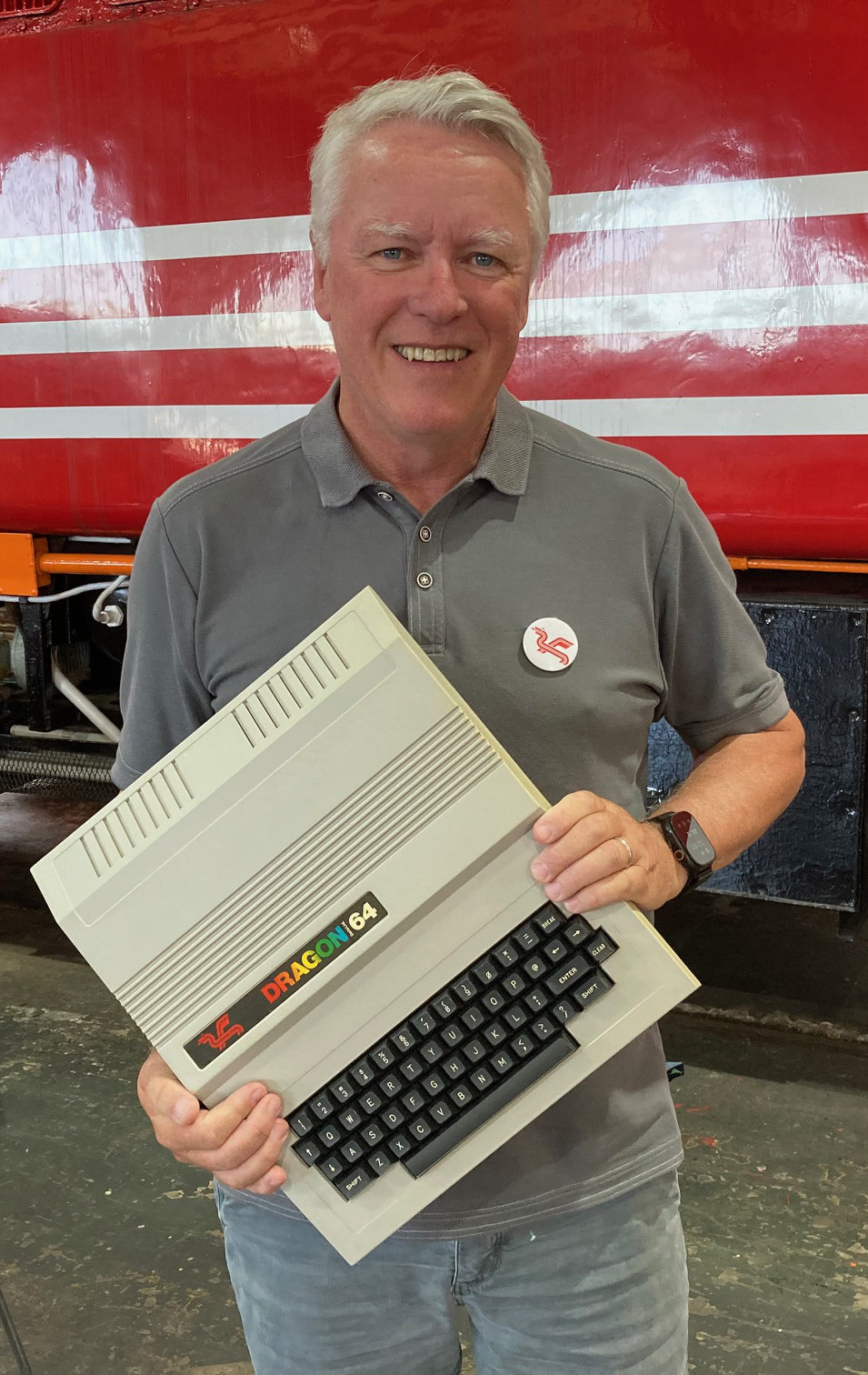
John Linney 2025
The Road to Dragon Data
John’s first job in computing wasn’t with Dragon Data but with
Kalamazoo Business Systems as a ‘computer operator’, with such tasks as
executing programs, loading tapes, and changing printer
ribbons, a major benefit of this job was that it included
attending computer night classes. After taking the “gap year”
at Kalamazoo and getting a foundation in computing from the night
classes, John joined the Bsc Computer Studies course at the
Polytechnic of Wales. Wales poly was one of the first real
Computer Studies courses in the early 80’s. Wales poly was quite
modern at the time, covering programming in Fortran and Assembly,
plus they had good (modern) equipment (VDU’s etc.), which some
universities at the time didn’t have. The course was 4 years with a
sandwich year ,with the sandwich year spent at IBM, on Wigmore St
London. This was around the time of the first PC release and there was
rivalry in IBM between the departments, IBM mainframe vs the newly
released IBM PC vs Typing (electric typewriters). John recalls the
company culture of IBM was somewhat off-putting, with one example
being their “optional” company picnic, but it
was made clear that your lack of attendance would be “noticed”. His final polytechnic project, was
a kitchen
design software/CAD program, that would also produce a quote and picking list.
John’s professor introduced him to a local kitchen installer who also
provided positive feedback. The kitchen design software would have taken quite a
bit to put into production so it didn’t go forward. John’s professor
also knew Derek Williams (Technical Manager) at Dragon Data, so a letter was posted off to Derek
enquiring about a job. He was shortly invited in for an interview and
after an ½ hour interview John was in at Dragon Data as a programmer!
Finally Graduating Wales polytechnic in 1983 at age 23, he was then
quickly onto Dragon at Kenfig.
Dragon Data
John joined the development team in August
'83 reporting to Duncan Smeed, who
had pretty much been on his own for software development up to this point. Taking up
residence in Porthcawl with Stewart Price (a “Jnr. hardware guy”), who did
all the wire wrapping for the hardware development prototyping. Initially he
had worries over joining such an experienced team (especially being
straight out of poly) but Duncan was great and people listened (to
his ideas etc.). For example when John designed and put the Beta logo in
the character ROM, “there were no design meetings, you were just trusted
to do the right thing”.
Primarily taken on to work on the Alpha/Beta prototypes, as the D64 was
done by the time he arrived. He described his work there as: “..worked on the
prototype of the twin processor Dragon 128 (8088 + 6809 if I remember
correctly**) and later, the more evolutionary twin disk (720K 3.5")
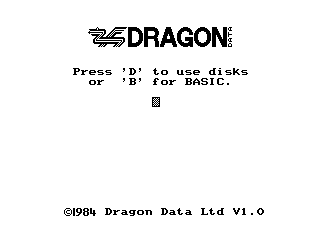
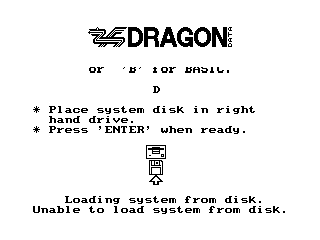
Alpha/Professional. I was also responsible for ongoing maintenance of
Dragon DOS (for the Alpha) which was originally done by an outside
contractor, fixing bugs in Microsoft ROM Basic (yes - the source contained
comments by Bill Gates), and driving various bits of hardware that we
added to the basic design including the modem, sound chips, disk drives,
the boot sequence etc... I have fond memories of creating products with
some pretty primitive development systems. I also designed and implemented
the Alpha boot screen. Used a special character set to do the (Dragon
logo) graphics". In addition to this work John also worked on
items including:
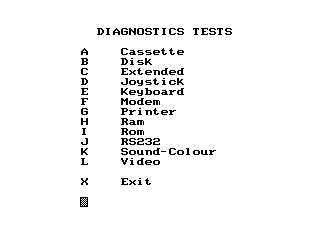
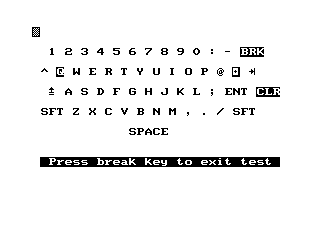
• Built in diagnostics on the Alpha.
• PRESTEL (most likely the
Alpha)
• Character set in the Beta ROM.
• Character set for the Alpha.
• "Simple" Graphics design / drawing program for the Beta
The development work was (primarily) on the Motorola
Development System
(6809 dev) and logic analysers. With it being common practice in
development to put patches directly into EEPROMs to jump out of the
problem area and into the patch. Once proven the code could be updated
in the source (by fixing the problem area) with the tested patch.
John recalled asking for a sound chip to be put into the Beta, but Jan
(Wojna), “who was a great h/w engineer” suggested to
‘waggle’ a pin for sound instead, ‘as sound chips cost money and software is free’.
When asked about the issues / problems at Dragon, he cited that the “Dragon 32 was the right product at the right time (for DD)”
but moving forward (DD) was “did not have the time or resources to carry out what
was needed (for the products). With the Beta needing business applications,
and better connectivity
such as a terminal emulator”.
This lack of software also led to “no priority in developing
to the Light-pen and Mouse on the Beta, as no direct
application was available at that time to use them”.
Financially
Dragon was getting into trouble at this time but John saw “no extravagances at Dragon Data”.
Whilst not involved in the Touchmaster tablet project which was being
developed by DD at the same time as the Alpha & Beta, he thought the “Touchmaster
was a very long shot,
especially after solving the touch layer separation issue
with bridal veil material”.
After only
9 months the Dragon experience was over, but John, Duncan, and Jan from the
development team stayed together as they moved on to Thorn EMI, to
work on
the Liberator project. So just as the doors began closing for the final time at
Dragon a new one opened at Thorn.
Summing up his time at Dragon Data with the development team, “It was
great… you could just do your work (empowered).
No one kicked you in the balls for just doing a task in your own way, it was such
a great experience (especially) for a first job,
with the opportunity to work with clever people”.
Liberation
The move to Thorn EMI working on the Liberator project, meant staying
in South Wales with a move up the valleys to Merthyr Tydfil.
John was responsible for writing the built-in word processor, file transfer and terminal emulator software.
Development was done out of an analogue (rotary dial) phone
production site and John remembers crossing picket lines, as they were
facing closure due to British Telecom phasing out rotary phones. A
quirk of working at the phone factory was that the Liberator team were
served lunch in a separate room (to the phone production staff) as
they were ‘management’.
Around 400-600 Liberators were made, and
“retrospectively it was more influential than we (the dev team)
thought (at the time), i.e. in the civil service people who used them loved them,
and it changed their ideas on computing/tech, with many not wanting to
give them up. This is even more relevant as many of it’s users hadn’t
used a keyboard, let alone a computer, (esp.) with many mangers etc.
who previously had secretaries”. Because of this lack of experience in
the user base, one of the pieces of software John wrote for the project
was ‘keyfam’ a keyboard familiarisation program, to aid new
computer users learn
how to use the keyboard. There was very little technology carry over
from the Dragon to the Liberator project “just experience”, his
experience of PRESTEL on the Dragon came in useful as it aided the writing
of a PRESTEL
terminal emulator for the Liberator. John recalled that years later in a job
interview, the interviewer being impressed that he had implemented
PRESTEL in monochrome.
Post Liberator
After the wrap up of the Liberator project and subsequent closure
of the Merthyr factory, John stayed with Thorn and moved to their
Bristol development centre. “Thorn was still big in consumer
products at this time” and had the opportunity to work on some
cool products, including early development of
a laptop “like the GRID (Compass)”.
John ported the Liberator applications to the IBM PC in anticipation of this.
But it was too late
for the market “Overdue”, with other companies coming into the laptop
market and the GRID failing, which sealed the fate of the project at Thorn.
The team also,
“Looked at a video jukebox, using vinyl disks (RCA CED) for video
playback, it went nowhere”.
After Thorn, John moved to Digital Reasearch at their UK development centre in Hungerford,
during his work there Digital Research was purchased by Novell.
Key points of note during his time there:
• Helping make Concurrent DOS compatible with MS-DOS which would become DR-DOS. TSR (Terminate and Stay Resident) programs being the
“Biggest difficulties”
• Porting Digital Research’s Graphical Environment Manager (GEM,
a Windows competitor) to run as a file manager on DR-DOS.
• Became product manager for DR-DOS before the end of the project.
• Novell DOS 7.
• and
being... “An engineer that could be put in front of a customer”
As work on DR-DOS wound down,
Novell made cuts which unfortunately led to John being made redundant, but this
wasn’t the end at Novell. Within a few weeks he was asked back to Novell,
and shortly moved to California. Initially working on marketing
Novell’s internet/LAN networking
products and then later moving into business development.
In 1999 the move was made to an E-commerce startup,
followed by other startups including, ‘CloudTalk’ (social media),
and later
‘SolarCity’, where he led marketing for 3 years, Solar City being founded by
two of Elon Musk’s cousins. Shortly after John left Solar City
it was merged into Tesla as
Tesla Energy.
John now enjoys his retirement in California with
his passion project Classic
Motor Films.
**
The known Beta (Dragon 128) prototype uses two 68B09's not an 8088 as suggested by
John. Duncan Smeed has also mentioned the 8088 before, so this
back's up John's comment. From conversations with John and
Duncan it seems that this never happened due to the difficulties of
using two processors with different architectures and assembly
language.
A big thank you to John for taking time out of his UK holiday to go over his Dragon Memories (and more).
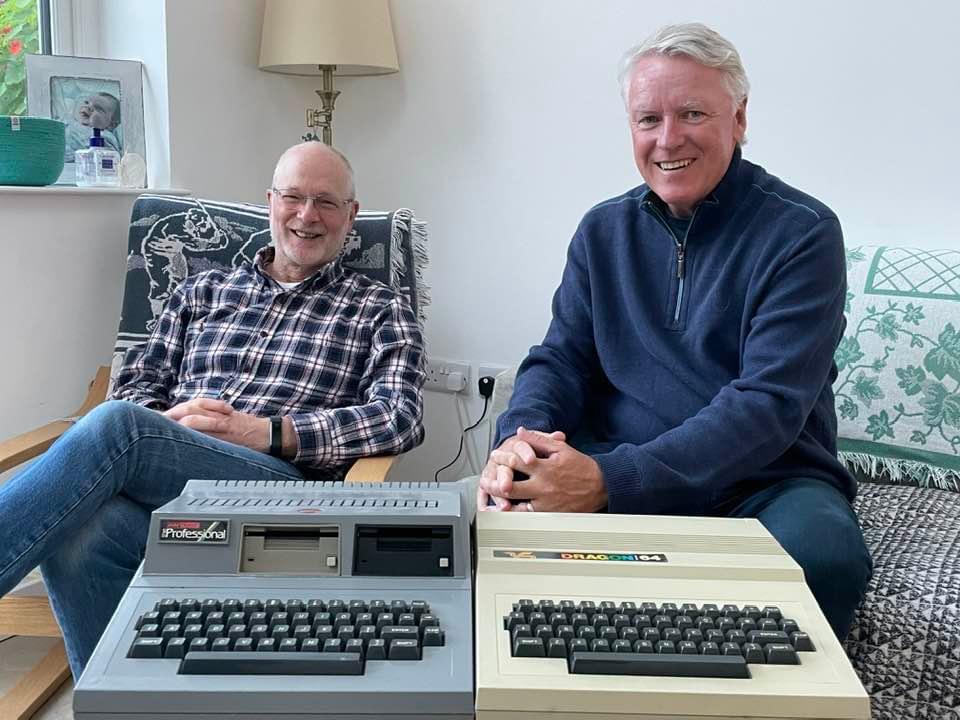
Duncan Smeed (L) and John Linney (2022)
 |
 |
 |
 |